
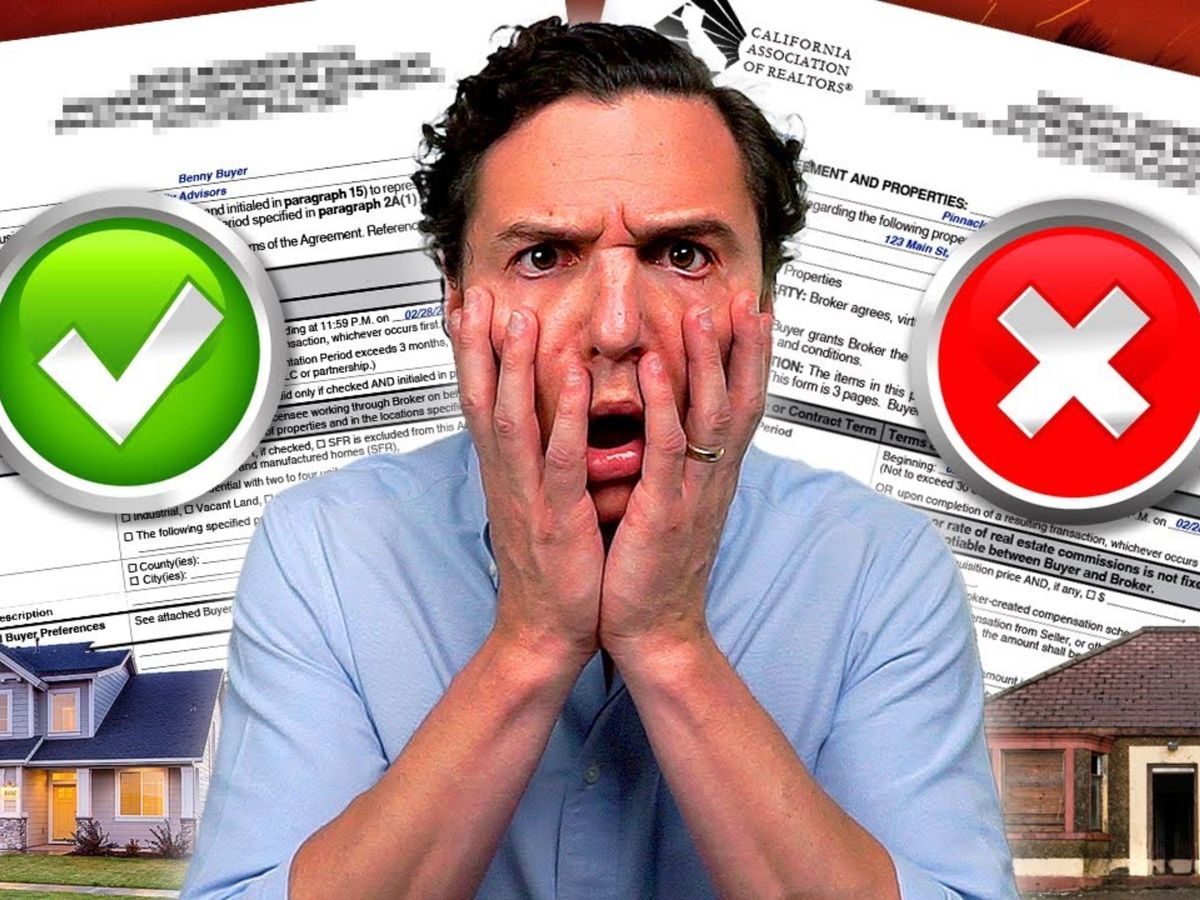
There is new paperwork wreaking havoc on California home buyers in 2025, and most people have no idea what they are actually signing.
These forms can lock you into working with an incompetent agent, or worse, force you to pay a commission to an agent who does not even represent you. And you are required to sign one before you view a single home.
Here is exactly what is safe to sign, what is not, and the one form you should never sign at all.
Quick Disclaimer
I am not a lawyer, and this is not legal advice. If you have questions about any of the legal documents discussed here, take them to a real estate attorney.
Watch Now
Watch my full video on this topic below, or watch it on my channel instead.
Where It Started
This whole mess grew out of an antitrust lawsuit that the National Association of Realtors lost and settled last year.
Some good came out of it. The rules about how agents get paid were reformed to add a little more transparency. But the Realtors also slipped in a gift to themselves: a new rule requiring home buyers to sign a representation agreement with a Realtor before viewing homes.
So now, whether you click “Request a Tour” on Zillow, call the listing agent directly, or follow up on a referral from family, the first thing you will be asked to do is sign a form that puts your relationship with that agent, and how much you owe them, in writing.
Four Forms
To create as much confusion as possible, the California Association of Realtors produced four different agreements. The good news is that two of them are completely safe to sign. The other two are where buyers get hurt.
Safe to Sign
The first safe form is the Open House Visitor Non-Agency Disclosure and Sign-In. You will see this at open houses, and it is 100% safe to sign. All it does is confirm what is already true: the agent selling the house does not represent you. Anything that agent says is for the seller's benefit, and they can repeat your conversation to the seller. That is true whether you sign or not, so signing costs you nothing.
The second safe form is the heavier Buyer (or Tenant) Non-Agency Agreement, an explicit statement that the seller's agent does not also represent you. By default nobody represents you unless you hire them, but California recognizes something called “implied agency,” so occasionally a seller's agent will want this in writing. If so, go ahead and sign.
The Dangerous Two
The next two forms are where you have to be very careful. These are the representation agreements you will run into the moment you connect with an agent to see homes. Sign the wrong one, or initial the wrong box, and you can lock yourself into a bad agent or end up paying an agent who does not even represent you.
They are the Buyer Representation and Broker Compensation Agreement and the Property Showing and Representation Agreement. Both set the commission your agent gets and how long you are tied to them, and both are filled with misdirection.
The Continuation Trap
Let's start with the Buyer Representation and Broker Compensation Agreement. It defines a representation period, which cannot exceed three months. Fair enough. But further down the page, under “Continued Right to Payment for Broker Involved Properties,” it defines a continuation period, and that one has no limit.
In plain English: even after your representation period ends, the agent can still be owed a commission on any home they were involved with during a continuation period that can run as long as they like.
My advice is simple: do not agree to a representation period longer than 30 days, and do not accept a continuation period longer than zero days. That is exactly the agreement I offer my own clients: a 30-day representation period and no continuation period.
False Comfort
The next trap is the Type of Representation. By default, this form is a non-exclusive representation agreement, which sounds reassuring. Non-exclusive should mean you are free to work with another agent if this one turns out to be a dud, right?
Not quite. A non-exclusive agreement means a commission is payable only if there was broker involvement, and broker involvement is defined incredibly broadly: showing a property, showing it virtually, submitting an offer, running a market analysis, or even just introducing you to a property.
So read that carefully. Even under a “non-exclusive” agreement, if the agent shows you a home, researches a home, or merely introduces you to one, you owe that agent a commission if you buy it, even if you would rather close the deal with someone else.
This is the line dishonest agents lean on. They will say, “You have to sign before we can look at homes, it is the new rule, but do not worry, it is non-exclusive, so you are not even obligated to work with me.” That is true-ish. But you are still obligated to pay them a commission on any home they showed you. This is exactly why you should talk to several agents and actively choose who you want before you sign anything.
Never Exclusive
Here is where it gets worse. Most agents are not satisfied with a non-exclusive agreement. Most will hand you a version with the “exclusive” box checked, which entitles the broker to a commission if you buy any property during the representation period, with or without their involvement, even if another broker also represented you.
So let me be blunt: never sign an exclusive representation agreement. If you find an agent you like better, too bad. If your uncle offers to sell you his condo with no agents involved at all, too bad. You have agreed to pay this one agent a commission no matter what. And by default, canceling an exclusive agreement requires 30 days' notice.
The California Association of Realtors knows exactly how heavy this is because, for it to take effect, you have to initial a special boxed section that repeats the same language. Whatever you do, do not initial the special boxed section! When I send these contracts to my clients, I do not even give them the option.
The Shortcut Trap
That leaves the Property Showing and Representation Agreement, and my advice is to never sign it at all.
The listings websites make a lot of money connecting buyers to agents, and contracts slow that machine down. So the California Association of Realtors produced this streamlined, two-page version to keep things moving. It works like the longer agreement, except you list specific properties, the representation period is capped at 30 days, and it can only be non-exclusive.
That is the pitch you will hear if you connect with an agent through Zillow: it is short, and it is non-exclusive. But you already know the catch. Showing a home counts as broker involvement, and broker involvement means a commission. So under this “non-exclusive” agreement, you are still committed to pay the agent who shows you those homes. Skip it, and stick with the longer Buyer Representation and Broker Compensation Agreement, filled out correctly, now that you understand it.
Smart Advice
So how do you protect yourself? Sign the two open house forms freely, since they cost you nothing. But before you sign either representation agreement, talk to several agents and actively choose the one you want. When you click “Request a Tour” on Zillow or “Request Showing” on Redfin, you are simply handed to whichever agent paid the most for the lead, and agents who buy leads are often the ones to avoid. Line up a few conversations while you are getting pre-approved, and pick your agent on purpose.
Conclusion
Agents love to talk about the value they bring, but most of them make their money by gatekeeping the process, and the new 2025 paperwork just hands them new ways to do it.
- Sign the open house forms freely; they cost you nothing.
- If you sign the Buyer Representation and Broker Compensation Agreement, keep the representation period at 30 days, set the continuation period to zero, and never initial paragraph 15.
- Never sign an exclusive representation agreement.
- Never sign the Property Showing and Representation Agreement.
Read the fine print, refuse the traps, and you keep control of both your home search and your money.
If you want to work with a California agent who offers a fair, 30-day, non-exclusive agreement with no continuation period and a 1% commission, that is exactly what I do.
Read more on this topic: what closing costs actually are, and how to get them down to zero.