
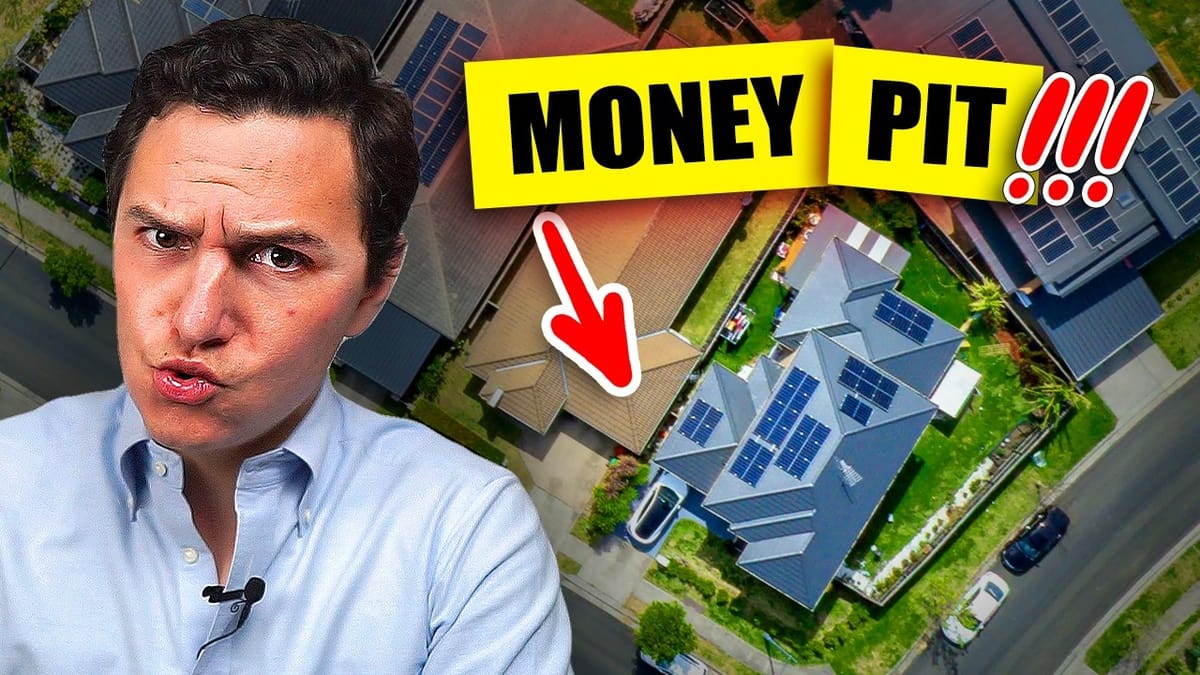
Buying a home in California is expensive. It gets even more expensive if you aren't working with a good agent who can keep you from making the same mistakes buyers make again and again.
In this article, I'm walking through the four most expensive mistakes I see California home buyers make.
My name is Jon Schwartz. I'm a California Realtor, I've helped buyers purchase over $80M of real estate, and I have saved my clients over $505,000 in unnecessary Realtor fees.
Watch Now
Watch my full video on this topic below, or watch it on my channel instead.
Foundation Issues
Let's start with a California classic. Mistake #4 is foundations, but it's not what you think.
The mistake is walking away from a California home because it has foundation issues. Here's why:
California is mostly soft soil because two tectonic plates are rubbing against each other right underneath us, and soft soil leads to foundation issues. I've had plenty of conversations with new clients who say they're open to a home that needs a little work, but they won't touch anything with a foundation issue. In California, that attitude carries a real opportunity cost.
Not all foundation issues are equal, and most of the time, if there is one, we can make it the seller's issue instead of yours.
The most common issue is vertical cracking. Foundations are poured concrete, a rigid material, so as the weight of the house settles into soft soil, the foundation is likely to crack vertically in one, two, or more places.
That's normal in California soil, and the fix is relatively cheap. A foundation contractor seals the crack with a polymer and installs something like a large staple across it to stop any separation. Fixing a crack costs about $1,000, and nine times out of ten, I've negotiated for the seller to pay for it.
Horizontal cracks are a bigger deal. They indicate pressure, usually from water, pushing against the sides of the foundation. Water does more damage to foundations than anything else, and it can destroy one in place.
That's what I recently ran into with clients buying a home in Los Angeles: the foundation was basically a pile of rubble. The only fix was to lift the house on stilts, remove the old foundation, and build a new one from scratch, at a cost of $45,000.
Did the buyers run for the hills? No. We asked the seller to pay for it instead.
Here's why that works: when you go into contract on a home, you usually have an inspection period, during which you hire inspectors to look for problems like foundation issues. You can then negotiate for the seller to make repairs. If you don't like how the negotiation goes, you can cancel the contract and get your earnest money deposit back. No harm, no foul.
And here's the part that actually gets sellers to pay: anything you share with the seller from your inspections has to be disclosed by the seller to any future buyer. So if you find a $45,000 foundation issue and the seller won't work with you to fix it, the seller is still obligated to hand that report to the next buyer and deal with it then. One way or another, the seller has to deal with it, so it may as well be with you.
That's the argument I made on the home in Los Angeles, and the seller paid for the new foundation. The foundation issue became a free foundation upgrade.
So don't run from foundation issues. Embrace them, with one caveat: be wary of homes on steep hillsides. When foundation issues are paired with eroding soil, get your inspections and get a handle on the repair cost, but there's a good chance the repair will be too expensive for either side to handle.
Sewer Scoping
Mistake #3 is not getting a sewer scoping.
A sewer scoping is an inspection add-on in which a camera on a long cable is run down the entire length of your sewer line, from your house to the public sewer main under the center of the street. It costs between $250 and $350, and most of the time it turns up very little. Most sewer lines are in fine condition. They aren't going to win any beauty pageants, but root intrusion is minimal and the line hasn't collapsed.
So why spend $350 to look at a home's poop chute? Think of a sewer scoping as an insurance policy. Nine times out of ten, the sewer is fine, but once in a blue moon, you find a very expensive problem, and I know that from personal experience.
The last house I bought was a fixer, so I skipped the sewer scoping because I figured I had budget for whatever we found. The problem we found was under the street. Homeowners are responsible for their sewer line all the way to the city main, which runs under the center of the street, so you might end up on the hook for a repair under the street itself. That's what happened to me.
A repair under the street means you have to excavate and then repair the street, and that requires special permits, a contractor with special licensing, and repairing the road to the city's standards. All of it adds expense. In my case, replacing a few feet of sewer line that might have cost $2,000 in a front yard ended up costing $18,375 because it was under the street.
Save yourself that risk. Get a sewer scoping during your inspection period.
Shopping for Loans
Mistake #2 is not shopping for the least expensive loan.
Most home buyers get a lender referral from an agent or a friend, have a positive conversation, and think they're done with the financing part. They aren't. You have to shop for the best loan terms by making two to four lenders compete for your business.
Buying a loan is a lot like buying a car. A dealership buys cars at wholesale prices from the manufacturer, then tries to sell them for as much as possible to pocket the difference. The best way to buy a car is to pit two dealerships against each other: let each one know what the other is offering so they start competing against each other instead of against you on price. You'll save thousands of dollars buying a car that way, and you'll save even more buying a loan that way.
The model is the same. Mortgage brokers and loan officers buy loans from wholesale lenders at wholesale rates, then try to sign you up at as big a markup as possible to pocket the difference. So as a home buyer, get pre-approved by two to four lenders so that, once you're in contract on a home, you can make those lenders compete against each other on pricing.
I walk through the full three-step system I teach my clients in Insider Secrets: 3 Steps to Scoring the LOWEST Mortgage Rate.
The Wrong Realtor
Mistake #1, the most expensive one, is working with the wrong Realtor.
There are over 200,000 active Realtors in the state of California. California has more Realtors selling homes than it has homes for sale!
Working with the wrong Realtor is expensive in countless ways. You can lose your earnest money deposit in escrow. You can get bad advice and end up buying a lemon. You can miss your dream home because your agent was too incompetent to write a compelling offer.
But here's what other Realtors won't focus on: the actual cost of your Realtor's commission, and how it can tank your deal.
Most Realtors take a 2.5% commission out of your offer. So a $1,000,000 offer is really worth just $975,000 to the seller (more on that here). Some Realtors have caught onto this and take a 2% commission instead, so a $1,000,000 offer is actually worth $980,000 to the seller. You can already see the buyer with the more reasonably priced Realtor has the advantage.
In my business, I give my clients every advantage possible by taking just a 1% commission. When my client offers $1,000,000, they're really offering $990,000. In this hypothetical, my client wins the bidding.
The cost of an expensive Realtor goes beyond the extra $15,000 or $20,000 of commission: it can cost you the home of your dreams because their commission sank your offer.
Conclusion
Those are the four most expensive mistakes I see California home buyers make: running from foundation issues instead of negotiating them, skipping the sewer scoping, settling for the first loan offer instead of shopping it, and working with a full-price Realtor whose commission tanks your offer.
If you want to avoid the last one by working with a reasonably priced 1% commission agent, book a free, no-commitment Zoom call at jonsch.com. No pressure, no commitment, just a conversation about how much you could save.
Read more on this topic: the vanishing California homeowner, and who is really buying homes here.